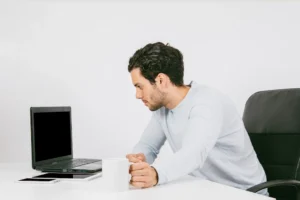

Hip pain that develops or worsens after prolonged sitting is one of the most common complaints I hear from Cedar Park’s remote workers, tech professionals, and office employees — and it’s almost always being caused by the same cluster of problems. The good news is that it responds well to treatment once those underlying causes are correctly identified and addressed.
Why Sitting Is So Hard on the Hips
The hip joint is designed for movement. It’s a ball-and-socket joint built to rotate, flex, extend, and absorb load across a wide range of motion. When you sit for hours at a stretch, you’re holding it in one position — roughly 90 degrees of flexion — with significant muscular tension and no dynamic load. That’s the opposite of what it’s designed for.
Several things happen simultaneously during prolonged sitting that set the stage for hip pain:
The hip flexors — the iliopsoas and rectus femoris muscles that run from the lumbar spine and pelvis to the thigh — are held in a shortened position for hours. Over days, weeks, and months of this pattern, they adaptively shorten and tighten. Tight hip flexors pull the pelvis into an anterior tilt, which flattens the lumbar curve, strains the sacroiliac joints, and compresses the structures at the front of the hip joint.
At the same time, the glutes — the primary stabilizers of the hip joint — become inhibited from being sat on all day. The technical term is “gluteal amnesia,” and it’s exactly what it sounds like: the glutes essentially forget how to activate properly. Without adequate glute function, the hip joint is destabilized and the smaller surrounding muscles have to overwork to compensate, leading to the deep aching in the hip and buttock that sitting-related hip pain typically produces.
The Sedentary Lifestyle Spiral
One pattern I see repeatedly in Cedar Park’s desk worker population is what I think of as the sedentary spiral. A sedentary lifestyle creates tight hip flexors and weak glutes. Those imbalances alter how load travels through the pelvis and lower back. The resulting pain makes movement uncomfortable, so the person sits more and moves less. The hip flexors get tighter, the glutes weaker, the joint more restricted — and the pain steadily worsens.
Breaking this spiral requires more than just standing up more often, though that helps. It requires actively addressing the structural changes that have already accumulated, not just preventing new ones from forming.
The Lumbar Spine and SI Joint Connection
Hip pain from sitting rarely stays isolated in the hip. Because the hip, pelvis, and lumbar spine are mechanically interconnected, dysfunction at any one of these points creates compensatory stress at the others.
Tight hip flexors from prolonged sitting pull on the lumbar vertebrae from below, increasing the compressive load on the lumbar discs and facet joints. The sacroiliac joints — which connect the sacrum to the pelvis on each side — are particularly vulnerable to the postural asymmetries that develop from habitual sitting, especially when someone consistently crosses the same leg or shifts weight to one side at their desk.
This is why patients with sitting-related hip pain often also have lower back pain, and why treating the hip without addressing the lumbar spine and pelvis frequently produces incomplete results. The whole system needs to be assessed and treated together.
The Muscle Imbalance Pattern in Detail
Prolonged sitting creates a predictable and well-documented pattern of muscle imbalances that I see consistently in desk workers across Cedar Park:
Tight and overactive: hip flexors, piriformis, TFL (tensor fasciae latae), lumbar erectors, and upper trapezius. Weak and underactive: glutes, deep core stabilizers, hip abductors, and mid-back muscles. This pattern — tight in front and on top, weak in back and underneath — pulls the pelvis forward, internally rotates the femurs, and loads the hip joint in exactly the way that produces anterior hip pain, deep buttock aching, and the sharp snapping or pinching sensation some desk workers feel when they stand up after a long period of sitting.
How Chiropractic Care Addresses Sitting-Related Hip Pain
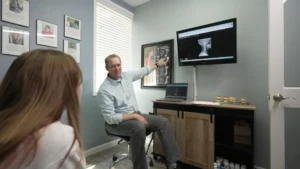
The assessment at Gateway to Wellness starts with understanding the full picture — not just the hip, but the lumbar spine, pelvis, and the movement patterns that are driving the problem. X-rays give us the structural picture. A hands-on orthopedic exam evaluates hip joint mobility, pelvic alignment, lumbar function, and the specific muscle imbalances present.
Our chiropractic adjustments address the joint restrictions that have developed — in the lumbar spine, the sacroiliac joints, and the hip joint itself — restoring the normal movement and alignment that prolonged sitting has disrupted. When the joints are moving freely and the pelvis is properly aligned, the muscles can finally begin to work the way they’re supposed to rather than compensating around restricted joints.
We also address the muscle imbalance component directly. Releasing the chronically tight hip flexors and activating the inhibited glutes are both essential parts of lasting recovery that adjustments alone don’t fully accomplish. I’ll give you specific techniques and exercises to work on between visits that accelerate the rebalancing process.
Practical Changes That Support Recovery
A few things that consistently help my Cedar Park desk worker patients alongside their treatment:
Stand and move for two to three minutes every 45 to 60 minutes — not because a short break undoes the structural damage of prolonged sitting, but because it interrupts the sustained hip flexor shortening and keeps circulation moving. When you sit back down, do a brief hip flexor stretch and a few glute activation exercises before returning to work.
Check your chair height. If your hips are lower than your knees when seated, you’re increasing the hip flexion angle and the compressive load on the anterior hip. A seat height that keeps your hips level with or slightly above your knees is significantly better for hip mechanics over long hours of sitting.
And if you’ve been putting off addressing hip pain because it’s not severe enough to disrupt your life yet — now is the right time. Sitting-related hip dysfunction progresses predictably if the underlying causes aren’t corrected, and the longer the muscle imbalance and joint restriction remain, the more work it takes to reverse them.
If sitting is causing hip pain in Cedar Park, Leander, or North Austin, we can help you identify what’s driving it and fix it properly. Contact Gateway to Wellness or call (512) 250-2224 to schedule your evaluation.