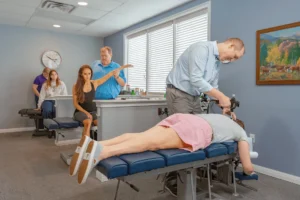

The connection between weight and back pain is more significant than most people realize. Even a modest amount of extra weight places substantial added strain on your spine, and it also fuels inflammation throughout the body, both of which contribute to chronic back pain. The encouraging part is that this connection works in your favor too, addressing your weight can meaningfully reduce your pain.
Let me explain how extra weight affects your back, and why it’s about far more than just the number on the scale.
The Simple Physics of Load on Your Spine
Let’s start with the most straightforward part. Your spine carries your body weight, and every extra pound adds to the load it has to support. But the effect isn’t one-to-one, it’s actually amplified.
Because of the leverage involved in how your spine and joints work, the pressure on your lower back increases by several pounds for every single pound of body weight, especially during activities like bending and lifting. So even a modest amount of extra weight translates into a considerably larger increase in the actual force on your lumbar discs and joints.
Think about carrying that load all day, every day, for years. The discs and joints of your lower back are under constant elevated pressure, which accelerates wear, contributes to disc problems, and produces the chronic aching and stiffness that so many people experience. This steady mechanical stress is a major part of the weight and back pain connection.
Where the Weight Sits Matters
It’s not just how much extra weight you carry, but where it sits. Weight carried around the midsection, which is common, has a particular effect on the spine.
Abdominal weight pulls your center of gravity forward. To compensate and stay upright, your lower back has to increase its curve and your posture shifts. This forward pull strains the lumbar spine, tightens the muscles of the lower back as they work to counterbalance, and changes how load is distributed through the spine.
The result is a posture and loading pattern that stresses the exact structures most commonly involved in back pain. It’s a bit like carrying a heavy bag in front of you all day, your back is constantly working to keep you balanced against that forward weight.
The Inflammation Factor
Here’s the part that surprises people, and it’s just as important as the physical load. Excess body fat isn’t just passive weight sitting there. Fat tissue, particularly around the midsection, is metabolically active and produces inflammatory substances.
This means carrying extra weight contributes to a state of chronic, low-grade inflammation throughout the body. And inflammation amplifies pain. It sensitizes the nervous system, makes existing pain feel worse, and slows the healing of injured tissues.
So extra weight contributes to back pain through two separate pathways at once. There’s the mechanical strain of the physical load, and there’s the chemical effect of increased inflammation. Together, they create a significant burden on a back that’s trying to stay healthy and pain-free.
The Vicious Cycle of Weight and Pain
One of the most challenging things about the weight and back pain relationship is how it can become a self-reinforcing cycle. Back pain makes movement and exercise uncomfortable, so people move less. Moving less makes weight management harder and can lead to further weight gain. Additional weight increases the strain and inflammation, which worsens the back pain, which makes movement even more difficult.
I see this cycle often in my Cedar Park practice. People get caught in a loop where the pain and the weight each make the other worse, and it feels impossible to break out of. Understanding the cycle is the first step, because it shows that addressing either side, the pain or the weight, can start to reverse it.
How Losing Even a Little Helps
Here’s the genuinely encouraging news. Because the load on your spine is amplified relative to your body weight, even a modest amount of weight loss produces a disproportionately large reduction in the strain on your back.
Losing even a small percentage of excess weight can meaningfully reduce the pressure on your lumbar discs and joints, and reduce the inflammatory burden as well. You don’t have to reach some ideal number to feel a difference. Many people notice their back feels better after losing a relatively modest amount, because the mechanical and inflammatory relief starts right away.
This is why I encourage patients not to feel overwhelmed by the idea of major weight loss. Small, sustainable progress delivers real benefits to your back, and those early wins often provide the motivation to keep going.
Breaking the Cycle: Where Chiropractic Comes In
Here’s where the pieces come together. To break the weight-pain cycle, you often need to address both sides, and reducing the pain enough to allow movement is frequently the key that unlocks everything else.
Our chiropractic care addresses the structural sources of your back pain, the joint restrictions, misalignments, and muscle imbalances that are contributing to your discomfort. When we reduce your pain and improve how your spine moves, movement and exercise become possible again. And once you can move comfortably, weight management becomes far more achievable.
Beyond that, we take a whole-person approach at Gateway to Wellness. Our weight loss support is integrated with chiropractic care, recognizing that your spine, your weight, your inflammation, and your overall wellness are all connected. Addressing them together is far more effective than treating any one in isolation.
The goal is to help you step out of that cycle, less pain allowing more movement, more movement supporting healthy weight, healthy weight reducing strain and inflammation, and the whole thing moving in a positive direction instead of a negative one.
Taking the First Step
If back pain and extra weight have been feeding each other and you’re not sure how to break the pattern, know that it’s very possible to turn things around, and it often starts with getting the pain under control so you can move again.
If the connection between weight and back pain is affecting your life in Cedar Park, Leander, or North Austin, we can help you address both sides of it. Contact Gateway to Wellness or call (512) 250-2224 to schedule your evaluation and start moving in a better direction.