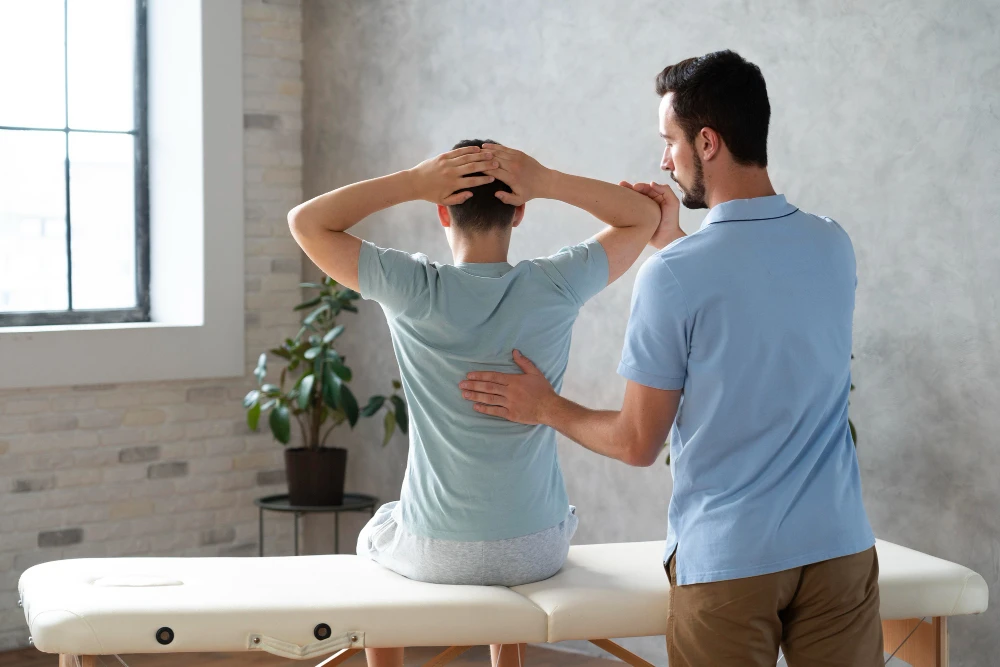
Lower back pain that’s consistently worse on one side — or only on one side — is telling you something specific about your body that general back pain treatment often misses. The asymmetry isn’t random. It almost always points to a pelvic imbalance, hip dysfunction, or compensation pattern that needs to be identified and addressed at its source, not just treated where it hurts.
Why One-Sided Pain Is Different from General Back Pain
Bilateral back pain — aching across the whole lower back — often comes from disc problems, general muscle fatigue, or diffuse postural stress. One-sided pain has a more specific mechanical cause. Something is loading or stressing one side of the body more than the other, and the lower back is where that asymmetry shows up as pain.
In my Cedar Park practice, I see this pattern constantly. A patient describes left-sided lower back pain that’s been present for months. They’ve tried stretching the left side, foam rolling the left glute, maybe even had massage focused on the left side. It helps temporarily but always comes back. The reason it keeps coming back is that the left side isn’t the source — it’s the victim of something else driving the asymmetry from another part of the body.
The Most Common Causes of One-Sided Lower Back Pain
Pelvic Imbalance
The pelvis is the foundation of the spine. When it tilts or rotates — even subtly — it creates uneven loading across the lumbar vertebrae and sacroiliac joints. One side of the lower back ends up under significantly more compressive load than the other, which produces exactly the one-sided pain pattern that so many patients describe.
Pelvic imbalance is incredibly common and often develops gradually from habitual patterns: crossing the same leg when you sit, standing with most of your weight on one hip, sleeping on one side consistently, or carrying a bag on the same shoulder every day. None of those things are obviously harmful, but over years they train the pelvis into an asymmetric resting position that the lumbar spine has to accommodate.
Sacroiliac Joint Dysfunction
The sacroiliac (SI) joint connects the sacrum — the triangular bone at the base of your spine — to the ilium of the pelvis on each side. These joints have very limited movement, but when they’re functioning well, that small amount of movement is important for shock absorption and load transfer.
When an SI joint becomes restricted or inflamed, it produces a characteristic deep, one-sided ache right at the beltline that can radiate into the buttock and sometimes down the back of the thigh. Patients often mistake it for sciatica because the pain travels similarly — but the mechanism and treatment are different. SI joint dysfunction responds very well to targeted chiropractic adjustments and typically doesn’t need the lumbar focus that sciatica does.
Hip Joint Dysfunction
The hip and the lower back are closely linked. When a hip joint is restricted, stiff, or arthritic on one side, the lumbar spine compensates to make up for the lost movement. That compensation creates asymmetric loading on the lower back — and consistently one-sided pain as a result.
This is why examining the hips is always part of my lower back assessment, even when the patient’s pain is clearly in the lumbar spine. Treating the lumbar spine without addressing a restricted hip on the same side is addressing the consequence without fixing the cause.
Leg Length Discrepancy
A true structural leg length difference — where one leg is anatomically shorter — is less common but creates significant spinal loading asymmetry. More common is a functional leg length discrepancy, where the legs are the same structural length but pelvic tilt or hip dysfunction makes one appear shorter. Either way, the longer-appearing side of the pelvis drops lower, creating a lateral bend in the lower lumbar spine and concentrating stress on one side.
I check for this in every new lower back patient. It’s one of those findings that, once identified and corrected, produces an immediate and noticeable change in how the lower back loads and feels.
Muscle Imbalance Patterns
Consistent one-sided activity — a dominant throwing arm, a job that requires repetitive reaching to one side, a sport with asymmetric loading like golf or tennis — creates muscle imbalances that pull the spine and pelvis out of alignment over time. The tight, overactive muscles on the dominant side pull joints toward them; the weak, underactive muscles on the other side can’t counterbalance. The resulting spinal asymmetry produces the predictable one-sided pain pattern.
Why This Pain Often Gets Worse Before It Gets Better (If Left Untreated)
One-sided lower back pain has a particular tendency to escalate over time in a way that general back pain doesn’t. The reason is compensation. Your body tries to offload the painful side by shifting weight, altering your gait, and changing how you sit and stand. Those compensations work temporarily but create secondary problems — on the opposite hip, in the opposite knee, in the thoracic spine — that add to your pain picture over months and years.
I’ve seen patients come in with what started as left-sided lower back pain that, over two years of compensation, has produced right knee pain, left shoulder tightness, and headaches — none of which they connected to the original back problem. When you treat the underlying cause of the asymmetry, all of those downstream problems tend to improve together.
How We Assess and Treat One-Sided Back Pain
The assessment starts with X-rays and a full postural analysis to see pelvic alignment, spinal curvature, and any leg length discrepancy. I then do a hands-on orthopedic exam that evaluates hip mobility, SI joint function, and lumbar movement — both the quality and the symmetry of that movement.
From there, chiropractic adjustments target the specific restricted joints — often the SI joint, the hip, and the adjacent lumbar segments — to restore symmetrical movement and reduce the uneven loading. We also address the postural habits and movement patterns that created the asymmetry in the first place, so the correction holds rather than just reverting between visits.
For most patients with straightforward one-sided lower back pain, the response to treatment is relatively quick once we’ve correctly identified the driver. The pain that seemed stubborn and hard to resolve often moves faster than expected when we’re finally treating the right thing.
FAQ
Does one-sided lower back pain always mean something serious?
In the vast majority of cases, no. One-sided mechanical back pain from pelvic imbalance, SI joint dysfunction, or hip restriction is very common and very treatable. That said, pain accompanied by fever, unexplained weight loss, or significant neurological symptoms like loss of bladder control warrants prompt medical evaluation to rule out non-mechanical causes.
Can sleeping on my side cause one-sided lower back pain?
It can contribute. Consistently sleeping on the same side — especially without adequate hip and knee support — can reinforce pelvic asymmetry over time. A pillow between the knees when side-sleeping is a simple way to reduce this. But if one-sided pain is already present, sleep position alone is unlikely to be the primary driver.
If you’ve been dealing with lower back pain that’s always worse on one side in Cedar Park, don’t keep chasing the symptom. Let us help you find what’s actually causing it. Schedule your evaluation at Gateway to Wellness or call (512) 250-2224. We serve patients throughout Cedar Park, Leander, and North Austin.