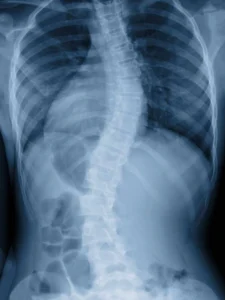

Pain between the shoulder blades is one of the most common complaints I see at Gateway to Wellness, and one of the most consistently misunderstood. That nagging ache, burning, or tightness in the mid-back usually isn’t a muscle problem you can stretch your way out of — it’s almost always a sign that something structural is driving the tension from underneath.
Why That Spot Is So Vulnerable
The thoracic spine — the middle section of your back that runs between your neck and lower back — connects to your rib cage, which limits how much it moves compared to the cervical and lumbar regions. That restriction means it’s less adaptable when postural stress accumulates. It can’t compensate the way your neck or lower back can, so it tends to hold tension and restriction in a concentrated way.
The muscles between and around your shoulder blades — the rhomboids, trapezius, and serratus anterior — are constantly working to stabilize your shoulder girdle and support your upper spine. When poor posture pulls your shoulders forward and rounds your upper back, these muscles are forced into a lengthened, overstretched position and work overtime just to keep you upright. The result is that familiar burning fatigue between the shoulder blades that builds as the day goes on.
But — and this is important — the muscle tension itself is usually a symptom. The underlying driver is almost always a restriction in the thoracic spine joints or a dysfunction that’s referred there from the cervical spine or the ribcage.
The Most Common Causes
Forward Head Posture and Rounded Shoulders
This is the root cause for the majority of my upper back pain patients in Cedar Park. When your head drifts forward of your shoulders — which happens naturally with prolonged screen time, desk work, or phone use — your upper back has to round to compensate. That rounded position compresses the front of the thoracic vertebrae and overstretches everything in the back. Over months and years, the joints in that region lose their normal movement and the muscles develop chronic tension patterns that don’t resolve with stretching alone.
Thoracic Joint Restriction
The thoracic spine has 12 vertebrae, each connected by facet joints that are designed to glide smoothly during movement. When those joints become restricted — from accumulated postural stress, a minor injury, or simply the body’s compensation patterns — they stop moving freely. The brain senses that restriction and responds by tightening the surrounding muscles protectively. That’s the ache you feel. Stretching the muscles temporarily relieves it, but the joint restriction that’s causing the muscle tension is still there, which is why the relief never lasts.
Ribcage Dysfunction
Less well-known but surprisingly common — ribs can shift subtly out of their proper position where they articulate with the thoracic vertebrae. When this happens, the surrounding tissues tighten dramatically and the pain can feel sharp, especially with deep breathing, twisting, or reaching overhead. Patients sometimes worry they’re having cardiac symptoms. In most cases, what they’re feeling is a rib that’s simply not sitting right, which responds very well to a targeted chiropractic adjustment.
Referred Pain from the Cervical Spine
The neck and upper back are neurologically interconnected. Neck problems — misalignment, disc irritation, joint restriction — frequently refer pain into the upper back and between the shoulder blades. I’ve had many patients come in convinced their problem was entirely in their mid-back, only to find on examination that the primary driver was in the lower cervical spine. Treating the wrong area explains why a lot of upper back pain doesn’t respond to standard treatment.
Muscle Imbalance from Sedentary Work
Prolonged sitting creates a predictable pattern: tight chest muscles and hip flexors, weak mid-back muscles and glutes. When the muscles that retract your shoulder blades — pulling them back and together — become chronically weak, the muscles in the front pull your shoulders forward into that rounded position. The muscle imbalance is the structural setup for the pain. Adjusting without addressing it gives you temporary relief; addressing both gives you lasting results.
Why Massage and Stretching Only Go So Far
Massage and stretching feel good on upper back tension — I’m not dismissing them. But they work on the muscular layer without addressing the joint restrictions and structural imbalances underneath. That’s why so many people find themselves getting massaged every few weeks indefinitely, always feeling better for a day or two before the tension returns. The muscles keep tightening because the underlying cause hasn’t changed.
This is one of the most common patterns I see in new patients. They’ve been managing their upper back pain for years with massage, foam rolling, and stretching — all of which provide temporary relief — and they come to us after finally getting tired of the cycle. Once we address what’s actually driving the tension, the relief tends to be more durable and the maintenance requirements go way down.
How We Treat Upper Back Pain at Gateway to Wellness
The assessment starts with understanding your full picture — posture, spinal alignment on X-ray, range of motion testing, and the relationship between your neck, upper back, and shoulder function. Upper back pain rarely exists in isolation, and treating it well means understanding what’s feeding it from above and below.
Our chiropractic adjustments for the thoracic spine restore proper joint movement in the restricted segments, which allows the surrounding muscles to relax and reduces the chronic tension cycle. For patients with significant soft tissue involvement, shockwave therapy and laser therapy accelerate tissue healing and reduce stubborn inflammation in the rhomboid and trapezius region.
We’ll also give you specific corrective exercises and postural habits to work on between visits — because if your daily posture is what’s creating the problem, we need to address that too, not just treat the symptoms it’s producing.
When to Take Upper Back Pain More Seriously
Most upper back pain between the shoulder blades is musculoskeletal and responds well to chiropractic care. That said, there are symptoms that warrant prompt medical evaluation rather than a chiropractic appointment: severe pain accompanied by shortness of breath, pain that radiates into your left arm or jaw, fever with back pain, or pain that worsens significantly when lying flat. These can indicate cardiac or other systemic issues that need to be ruled out first.
For the vast majority of patients — whose pain builds through the day, worsens with prolonged sitting, and improves temporarily with movement or massage — a chiropractic evaluation is exactly the right starting point.
If you’re dealing with persistent pain between your shoulder blades in Cedar Park, Leander, or the North Austin area, we can help you figure out what’s actually driving it. Schedule your evaluation at Gateway to Wellness or call (512) 250-2224.